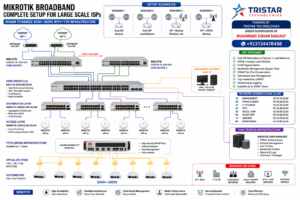
The job placement program focuses on key industry certifications and technologies used by Internet Service Providers (ISPs) and telecom operators. It combines Cisco, MikroTik, and OLT vendor technologies (BDCOM, VSOL, Huawei, C-Data) — three of the most critical domains in today’s networking landscape.
The Core Certifications:
- CCNA (Cisco Certified Network Associate) – Cisco certification covering enterprise networking fundamentals.
- MTCNA (MikroTik Certified Network Associate) – MikroTik entry-level certification for router configuration and management.
- MTCRE (MikroTik Certified Routing Engineer) – Advanced MikroTik certification focusing on routing protocols and ISP-level deployment.
- OLT Management (BDCOM, VSOL, Huawei, C-Data) – Hands-on experience managing fiber optic networks and equipment used in FTTx deployments.
The Main Domains Covered:
- Enterprise networking (LAN/WAN)
- ISP-level routing and switching
- FTTx (Fiber-to-the-Home / Fiber-to-the-Building)
- OLT (Optical Line Terminal) configuration and maintenance
- Network operations and troubleshooting
🔹 Career Roles You’ll Be Prepared For
✅ 1. Network Engineer / Support Engineer
Core Skillset:
- Cisco (CCNA): Understanding IP addressing, subnetting, VLANs, routing, and switching for enterprise environments.
- MikroTik (MTCNA & MTCRE): Configuring and managing routers for ISPs — PPPoE, DHCP, NAT, routing (OSPF, BGP, static routes), bandwidth management, and monitoring.
- OLT & FTTx Knowledge: Working with BDCOM, VSOL, Huawei, or C-Data OLTs for last-mile fiber connections.
Typical Responsibilities:
- Design and configure LAN/WAN infrastructure.
- Manage routing policies for ISPs.
- Troubleshoot network outages and optimize performance.
- Integrate Cisco and MikroTik systems in hybrid environments.
- Support customers or internal teams on connectivity issues.
Where You Can Work:
- Internet Service Providers (ISPs)
- Data centers
- Managed service providers (MSPs)
- Large enterprises with in-house networks
Career Growth Path:
Network Engineer → Senior Network Engineer → Network Operations Lead → Network Architect
✅ 2. FTTx Engineer
Core Skillset:
- Managing and configuring OLT devices from multiple vendors (BDCOM, VSOL, Huawei, C-Data).
- Understanding PON (Passive Optical Network) architecture — OLT, ONU/ONT, splitters, and fiber topology.
- Deploying and maintaining GPON/EPON systems for residential and business internet services.
Typical Responsibilities:
- Plan and execute fiber network rollouts.
- Configure OLT and register ONUs.
- Manage bandwidth profiles and VLANs on fiber networks.
- Troubleshoot optical link issues (using tools like OTDR or power meters).
- Maintain high-availability and fault-tolerant fiber access infrastructure.
Where You Can Work:
- Telecom companies
- Regional ISPs or fiber deployment contractors
- Network infrastructure projects
Career Growth Path:
FTTx Technician → FTTx Engineer → Network Deployment Manager → Fiber Network Architect
✅ 3. System / Network Administrator
Core Skillset:
- Managing mixed environments with Cisco, MikroTik, and OLT devices.
- Handling server-side operations — DHCP, DNS, monitoring tools (The Dude, Zabbix, PRTG).
- Implementing security — firewall rules, VPNs, user authentication, and QoS.
Typical Responsibilities:
- Maintain uptime for internal and external network systems.
- Monitor performance and detect anomalies.
- Apply network security policies and manage user access.
- Manage routing, switching, and fiber access devices.
- Provide technical support and documentation.
Where You Can Work:
- Enterprises with large IT infrastructures
- ISPs or WISPs managing their own network backbone
- Educational institutions or government IT departments
Career Growth Path:
System Admin → Network Admin → Network Infrastructure Manager → IT Operations Head
🔹 Why This Combination Is Powerful
This program uniquely blends three major layers of networking:
| Layer | Technology | Benefit |
|---|---|---|
| Enterprise (LAN/WAN) | Cisco CCNA | Strong foundation for structured, scalable enterprise networks |
| Routing & ISP-level management | MikroTik MTCNA + MTCRE | Hands-on control, cost-effective routing for service providers |
| Access Layer (Fiber) | OLT vendors (BDCOM, VSOL, Huawei, C-Data) | Real-world fiber deployment experience |
This combination ensures that graduates can:
- Design and deploy complete ISP infrastructures
- Operate and troubleshoot end-to-end network systems
- Work with both copper (Ethernet) and fiber (PON) technologies
🔹 Example Real-World Applications
- Setting up PPPoE servers and Hotspot systems for ISPs using MikroTik.
- Integrating Cisco core routers with MikroTik edge routers for load balancing or redundancy.
- Configuring FTTx deployments using Huawei or BDCOM OLTs and provisioning ONUs for new customers.
- Building network monitoring systems for uptime and performance tracking.
- Implementing QoS and bandwidth management for residential or corporate users.